TPCH Announces Continuum of Care Board and Committee Seats
On June 28, 2024, the United States Supreme Court ruled that people sleeping outside could be ticketed and after multiple tickets, jailed for thirty (30) days. The Court stated that these penalties were neither cruel or unusual because they didn’t inflict terror or pain and were not unusual to the city’s other punishments. See City of Grants Pass, Or. v. Johnson, 603 U.S. 1 (2024). The Court also stated, “Under the city’s laws, it makes no difference whether the charged defendant is homeless, a backpacker on vacation passing through town, or a student who abandons his dorm room to camp out in protest on the lawn of a municipal building.” Id.
The Tucson Pima Collaboration to End Homelessness disagrees wholeheartedly with this ruling. Our unhoused neighbors will be disproportionately affected by laws that could inflict similar punishments. As Justice Sotomayor states in her dissent, “Homelessness in America is a complex and heartbreaking crisis. People experiencing homelessness face immense challenges….” See Sotomayor dissent, Grants Pass. The ideology behind these laws is to exclude people from our community based on their unhoused status. Barriers created by fines and potential warrants will make it extremely harder to become housed. Our Continuum has focused its effort and housing first and services for the whole person. We do not seek to further punish those who are experiencing houselessness by a creation of barriers that will not deter folks from sleeping outside.
Click here for more info on how to address homelessness without criminalization
TPCH Announces Continuum of Care Board and Committee Seats
The TPCH 2024 Continuum of Care Election Process Has Concluded
Newly seated members will begin terms July 1, 2024
Through participation from Tucson Pima Collaboration to End Homelessness General Council members, members of the CoC governing board and five committees are now seated. TPCH welcomes the perspectives and expertise of our new board and committee members in our mission to prevent and end homelessness in Tucson and Pima County.
Continuum of Care Board
The CoC Board serves as the primary decision-making body for TPCH. The CoC Board acts on behalf of the TPCH General Council in setting policy and governing oversight for our coalition. Board Members participate in monthly CoC Board Meetings and to contribute time and effort to CoC activities throughout the year. Board members are elected by the TPCH General Council.
Yvette Gonzales, Pima County
Bernadette Unterbrink, Community Bridges Inc.
Randi Arnett, Primavera Foundation
Charles Dunn, St. Francis
Anna Santa-Cruz, DKA (Dorthy Kret & Associate)
Victor Bueno, Department of Economic Security
Lisa Floran, United Way
System Performance Evaluation
Amaris Vasquez, City of Tucson & Pima County
Paula Dwornicki, Primavera Foundation
Michael Macrie-Shuck, Primavera Foundation
Ellie Millyard, City of Tucson
Colleen McDonald, Our Family Services
Keith Bentele, UA SIROW
Louisa Osborn, Compass Affordable Housing
Congratulations to all those joining in the work to prevent and end homelessness in Pima County! All Board and committee members are expected to abide by the TPCH Code of Conduct and TPCH Conflict of Interest Policy.
Happy Pride Month from the TPCH; free LGBTQ+ Affirm Workshops Available for Youth and Caregivers
The Tucson Pima Collaboration to End Homelessness wishes a Happy Pride Month to all community members of all identities.
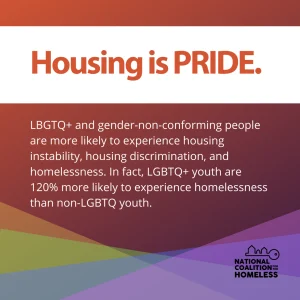
Housing is Pride. With the incidence of homelessness higher for those in the LGBTQIA+ community proportionate to their share of the population, the Tucson Pima Collaboration to End Homelessness is committed to achieving equity in the mission to prevent and end homelessness in Pima County.
Major areas of focus in the 2020-2025 In TPCH Community Plan include evaluating and addressing disparity in access to and use of temporary housing services among Black, Indigenous, and People of Color, LGBTQ+ people, and non-citizens, as well as evaluating discharge from shelter and supportive housing programs disparately impacting Black, Indigenous, and People of Color; LGBTQ+ people, and non-citizens. Learn more about the work TPCH is doing here to face these challenges in our community.
For LGBTQIA+ Youth and their caregivers, the Family Pride Initiative is hosting a series of workshops to learn and foster positive coping skills, feel affirmed and foster gender affirming practices, and promote the safety and well-being of LGBTQIA+ youth overall. Learn more at the flyer, embedded below for download.
TPCH Releases 2024 Point in Time Count & Shelter/Supportive Housing Utilization Reports and Results Summary
The Annual Homeless Point-in-Time (PIT) count, designed to provide a snapshot of households experiencing homelessness on a single night, was conducted in Pima County on January 24, 2024. This survey was supported by the efforts of more than 500 community volunteers, government agencies, and partnering non-profit staff. The 2024 count identified 2,102 people in 1,503 households residing in shelter, transitional housing, or living without shelter in Pima County the night of January 23, 2024.The PIT count, which is required by the U.S. Department of Housing and Urban Development, is used in program planning across shelter, housing, and supportive services. The count includes individuals and families residing in emergency shelter or transitional housing, as well as people living without shelter.
These Point in Time Count results provide an overview of homelessness within the region, with total counts of all persons experiencing homelessness on the night of January 24, 2024 in Pima County, Arizona. Full detail of the data submitted to the U.S. Department of Housing and Urban Development is also available at https://tpch.net/data/hic-pit/.
Preliminary data demonstrates a decrease in the incidence of unsheltered homelessness. There are some factors that could have contributed to this, including high levels of rain this week that were accompanied by flood warnings and freezing conditions, causing some unsheltered residents to seek safety outside of the normal areas where people experiencing unsheltered homelessness regularly congregate. A fuller analysis of this data is forthcoming.
While an imperfect measure, the annual count is an important tool used to inform priorities for federal, state, and local funding. It also helps identify trends and craft solutions for the needs of vulnerable individuals and families. The analysis and overall trend data are utilized by the Tucson Pima Collaboration to End Homelessness as one of many tools to track progress toward goals to prevent, reduce, and end homelessness. Additional information about this year’s count and historical Tucson/Pima County PIT data can be explored at https://tpch.net/data/hic-pit/.
Summer Sun Respite and Cooling Stations Available for People Experiencing Homelessness
Pima County Heat Relief Resources: Cooling Centers and Summer Sun Respite
In collaboration with the Pima County Health Department, the Tucson Pima Collaboration to End Homelessness (TPCH) has released a list of all summer sun respite and cooling center sites for those experiencing homelessness in Pima County. This flyer is available for download from the TPCH website, but in addition, Pima County has made an entire heat relief webpage including a map of all summer sun respite and cooling center locations for the community to access.
In addition to these resources, Pima County has convened a Joint Heat Action Team (JHAT) to better coordinate services for those navigating extreme heat in our community. Several updates may support providers in better connecting those experiencing homelessness to heat relief resources. For providers interested in learning how to treat Heat Related Illnesses, training is available on the TPCH Online Learning Center. Click the "E-learning" link at the top of this page to access this training and more.
A flyer including all summer sun respite and cooling center sites is available for download at tpch.net. This flyer will be frequently updated, so click below to access the most updated version.
Download the 2024 Summer Sun Cooling Station flyer (English and Spanish):
HEAT RELIEF ANNOUNCEMENTS
Additional Cooling Centers Open at Amazon Shelter
Two new “COOLtainers,” provided by the Arizona Department of Health Services and the governor’s office, were placed at the Amazon Shelter, 1135 W. Miracle Mile, to provide a restful place for people to get out the sun and heat. The Amazon is a shelter operated by the Housing First Division of the City of Tucson’s Department of Housing and Community Development (HCD).
HOURS: Tuesday - Saturday 12-5:30pm, operating until August 31, 2024
AMENITIES: In addition to the pods, HCD’s portable shower will be available at Amazon but that schedule has not yet been set. Inside the “quiet COOLtainer” there will be cots for individuals to nap or rest. Both COOLtainers have television and staff is working on securing internet service for people to access Wi-Fi on their devices. In the second COOLtainer there are board games, dominos, cards, adult coloring books, snacks, and hygiene items.
211 Arizona to offer rides to cooling centers, respite centers, and hydration station sites during Arizona’s hot summer months
Transportation through this program is not appropriate if you are experiencing any symptoms of heat-related illness or other medical emergency. Warning signs and symptoms of heat-related illness are available on the Centers for Disease Control and Prevention website.
If experiencing a medical emergency or any symptoms of heat-related illness, call 911 immediately.
Eligibility - Rides may be provided to:
Cooling Centers: Indoor, air-conditioned locations that offer hydration.
Respite Centers: Indoor, air-conditioned locations that offer hydration and allow for uninterrupted rest, sitting, or lying down (depending on each facility) during hours of operation.
Hydration Station Sites: Locations where individuals can go to receive bottled water and other collected donated items. These can be indoors or outdoors.
Riders:
Must be in a Lyft Service Area with a Cooling Center, Respite Center, or Hydration Station Site
Must be 18 years or older (unless accompanied by a parent/guardian)
Must be able to get into and out of a car, on their own, and without assistance
Must comply with Lyft’s Health Safety Commitment
Rides should be used when no other resources are available and to overcome short-term barriers.
City of Tucson Calls for Participation in Focus Groups on Unsheltered and Sheltered Homelessness
City of Tucson Seeks Community Input on People, Communities, and Homes Investment Plan
Join the City of Tucson and TPCH for an interactive discussion of the City of Tucson’s priorities as they relate to providing and funding services for persons experiencing homelessness. In this special input session, TPCH member agencies and others working to prevent and end homelessness will have an opportunity to provide direct input into the City of Tucson’s next People, Communities, and Homes Investment Plan (P-CHIP) which guides the Housing and Community Development Department’s (HCD) non-profit grantmaking activities.
During the session, attendees will be asked to respond to three priority questions:
What are the greatest challenges related to homelessness being experienced in our community today?
What strategies or priorities should the City use and fund to create the biggest impact toward ending homelessness?
What best practices are working locally or elsewhere that should be considered within the City of Tucson?
Your input will directly inform the P-CHIP strategic plan and HCD’s funding priorities for the next five years.
In-Person Event Details
June 13, 2024 (9:30am-11am)
320 N Commerce Park Loop – Sentinel Building
Tucson, AZ 85745
No registration necessary, please join us in person for this important discussion!
TPCH 2024 Continuum of Care Board and Committee Election
TPCH CONTINUUM OF CARE BOARD AND COMMITTEE ELECTION
ALL VOTES ARE DUE BY 11:59PM TODAY Thursday, May 23rd
ELECTION MATERIALS
This package includes:
Overview of the election process and voting instructions
Roster of current members of TPCH General Council with voting privileges as of May 9, 2024
Roster of seated CoC Board Members
Roster of CoC Board and Committee candidates
Listing of CoC Board and Committee candidates with disclosed areas of expertise as defined by the TPCH Committee Composition Operating Policy and key diversity goals
Candidate statements of interest and affiliations
Overview of CoC Committee purpose and summarized responsibilities
Quick Reference tool identifying candidates by organization and bodies to which each candidate has applied
Only one ballot may be cast for each TPCH voting organizational member identified in the membership roster. Multiple votes from the same organization will not be accepted.
Ballots may not include votes for more candidates than are eligible for election on any voting body. The ballot indicates the total number of votes that can be cast for each voting body.
No individual may serve on more than two (2) elected bodies of the Continuum of Care (CoC Board + 1 Committee, or 2 Committees).
No agency may have more than two (2) representatives seated on any elected body. If an agency has two (2) elected representatives on a single elected body, each representative will have one vote on all actions taken by the elected body.
All ballots must be cast online no later than 11:59pm tonight Thursday, May 23rd.
U of A Southwest Institute for Research on Women releases census updates to Housing Insecurity and Potential Homelessness Report
The University of Arizona Southwest Institute for Research on Women has released its most recent update to its report on Housing Insecurity Indicators and Potential Homelessness Estimates for Arizona and Pima County. This report measures current housing insecurity with newer census data.
This most recent survey wave contains multiple positive developments:
The positive macroeconomic situation has continued to hold steadily at both the national and state levels.
The unemployment rate in Arizona, 3.8% in March 2024, is a modest decrease relative to 4.1% in February and remains below historical averages.
In the previous survey wave, collected February 6th-March 4th 2024, the proportion of non-current renters in Arizona was 6.3%. In the most recent survey, conducted March 5th-April 1st 2024, this proportion rose very slightly to 6.7%.
The proportion of these non-current renters viewing eviction in the next two months as “very likely” remained very low at 8.5% (9.9% last survey wave).
Throughout all of 2023 housing insecurity among Arizona renters remained stubbornly high despite historically low unemployment.
These last two survey waves contain the first clear signals that the breadth of housing insecurity in Arizona is easing substantially. That said, lower-income and BIPOC Arizona households remain disproportionately likely to report being not current on their rent payments and finding it very difficult to meet usual expenses.
The National Equity Atlas estimated that 79% of non-current renters in Arizona are POC and 75% are low-income (based on the Census HPS data wave collected Jan 9th-Feb 5th 2024).
Mortgage holders in Arizona continue to be in a strong financial position relative to renters.
Only 4.2% reported being not current on mortgage payments (down slightly from 5.3% last wave).
Although among this small share of non-current mortgage holders concern about the likelihood of foreclosure in the next two months increased this wave to 16% from only 1% last wave.
Among non-current Arizona renters, the depth of rental debt has decreased.
This most recent survey indicates that, among Arizona renters who are behind on their rent, 66%, are only behind on their payments 1 month or less.
And 71% of non-current Arizona renters were only 2 months behind on rent or less.
In the fall of 2022 Tucson rent prices began decreasing on average, albeit very modestly.
In the Spring of 2023 rent prices in Tucson registered modest upticks in median/average rent prices. Despite these increases, seasonally adjusted metrics of Tucson rent prices increased only 3.5% between April 2023 and April 2024.
This is a substantial slowdown in the rate of rental price increases we have seen in recent years.
In addition, there is unambiguous good news in the rental vacancy rate, which has been trending upwards since the end of 2021, and hit an 8-year high in the 1st quarter of 2024. However, countervailing signals worth attention include:
only 51% of all Arizona respondents reported they had not experienced pressure to move in the last 6 months, down from 62% of respondents reporting no pressure last wave.
67% of Arizona renters reported an increase in their monthly rent in the last year (up from 57% last survey wave) and 50% reported an increase of $100 or more (up from 43% last wave).
The most significant development in this report is that eviction filings have fallen substantially since January and suggest a substantial easing of housing insecurity among Pima County renters.
Relative to a peak of 1307 eviction filings in January of 2024, the count of eviction filings fell 41% to 771 in April. We have not seen the monthly count of eviction filings this low since November of 2021.
Other metrics suggest continuing reason for concern:
12% of Arizona households reported reducing or not paying expenses for basic household necessities (such as medicine or food) “almost every month” in the last 12 months to pay an energy bill (66% of households reported “never” being in this situation).
Credit card debt balances nationwide and in Arizona have increased 33% between Q4 2022-Q4 2023.
And since November of 2023, counts of calls to 211 from Pima County indicate a very substantial increasein calls related to housing and shelter and utilities in recent months.
TPCH 2024 Continuum of Care Board and Committee Election
TPCH CONTINUUM OF CARE BOARD AND COMMITTEE ELECTION
ALL VOTES DUE BY 11:59PM ON Thursday, May 23rd
Please attend the General Council on May 9th when the voting materials for this year's election will be reviewed. Members of the TPCH General Council with voting privileges are eligible to vote on all vacant Board and Committee seats.
ELECTION MATERIALS
Stay tuned, as these election materials will be posted soon. This package will include:
Overview of the election process and voting instructions
Roster of current members of TPCH General Council with voting privileges as of May 9, 2024
Roster of seated CoC Board Members
Roster of CoC Board and Committee candidates
Listing of CoC Board and Committee candidates with disclosed areas of expertise as defined by the TPCH Committee Composition Operating Policy and key diversity goals
Candidate statements of interest and affiliations
Overview of CoC Committee purpose and summarized responsibilities
Quick Reference tool identifying candidates by organization and bodies to which each candidate has applied
Voting will occur online, starting May 9, 2024. Stay tuned Thursday, May 9th for the posting of the ballot.
Only one ballot may be cast for each TPCH voting organizational member identified in the membership roster. Multiple votes from the same organization will not be accepted.
Ballots may not include votes for more candidates than are eligible for election on any voting body. The ballot indicates the total number of votes that can be cast for each voting body.
No individual may serve on more than two (2) elected bodies of the Continuum of Care (CoC Board + 1 Committee, or 2 Committees).
No agency may have more than two (2) representatives seated on any elected body. If an agency has two (2) elected representatives on a single elected body, each representative will have one vote on all actions taken by the elected body.
All ballots must be cast online no later than 11:59pm on Thursday, May 23rd.
TPCH has spent all available Prevention and Rapid Resolution Funds
Thank you to all case managers that helped apply for and distribute the TPCH Prevention and Rapid Resolution Funds through the community!
We spent all of our original $400,000 back in June, and have now spent the additional $200,000 that was dedicated to the program. With this, we do not have any more funding to continue this program. Case managers are encouraged to continue working with clients to determine alternative sources of funding and assistance.
Thank you once again for your assistance with getting these funds to the community.